Energy-Efficient Facility Lighting: Implementing Closet Lighting LED Solutions
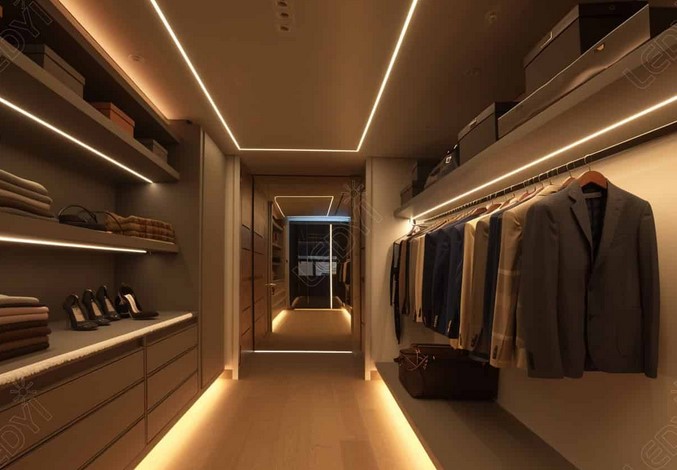
Source:https://www.ledyilighting.com
You are standing in front of your closet at 6:00 AM, squinting into a dark abyss, trying to distinguish between a navy blue sock and a black one. You reach for the pull-chain of that ancient, heat-omitting incandescent bulb, only to find it’s burned out—again. Or worse, you realize the heat from that old bulb has been slowly “cooking” the fibers of your favorite suit stored on the top shelf.
In my decade spent retrofitting residential and commercial spaces, I’ve found that the closet is often the most neglected “facility” in the building. We spend thousands on kitchen pendants and living room chandeliers, yet we leave our storage spaces in the dark ages.
Transitioning to Closet Lighting LED solutions isn’t just an aesthetic upgrade; it’s a fundamental move toward energy efficiency and fire safety. I’ve seen LED conversions reduce localized heat signatures by 80%, effectively ending the “scorched shelf” syndrome I’ve encountered in hundreds of older homes.
1. The Physics of Light: Why LEDs are the Only Choice for Closets
In the home improvement world, we look at the Luminous Efficacy of a fixture—how much light it produces versus how much power it consumes. Old-school bulbs are essentially heaters that happen to produce a little bit of light as a byproduct.
Think of an incandescent bulb like a leaky faucet; you’re paying for a full stream of water, but half of it is just dripping into the drain as wasted heat. A Closet Lighting LED is like a precision-engineered valve. It converts almost 95% of its energy directly into photons, keeping your clothes cool and your electric meter slow.
From a technical standpoint, closets are “enclosed, unventilated spaces.” Installing a high-heat source in a room filled with flammable textiles is a risk I never let my clients take anymore.
2. Choosing the Right Spectrum: CRI and Color Temperature
One of the biggest complaints I hear from homeowners is: “I installed LEDs, but now my closet looks like a cold hospital wing.” This happens when you don’t understand Color Temperature (Kelvin) and CRI (Color Rendering Index).
The Kelvin Scale
-
2700K – 3000K (Warm White): Gives a cozy, traditional feel. Best for wood-toned walk-in closets.
-
4000K (Cool White/Neutral): This is the “Contractor’s Sweet Spot.” It mimics natural daylight, which is essential for accurately matching clothing colors.
The Power of High CRI
If you want to move from a beginner to an intermediate home improver, look for the CRI rating. A CRI of 90 or higher ensures that red looks red and green looks green. I once had a client who thought their black dress was charcoal gray for three years until we installed a High-CRI Closet Lighting LED strip.
3. Implementation Strategies: Hardwired vs. Battery-Powered
As a pro, I categorize closet lighting into two main execution paths based on your “facility” constraints.
Hardwired LED Channels
If you are doing a renovation, go hardwired. We use Low-Voltage LED Tape recessed into aluminum channels with opal diffusers.
-
The Look: It creates a “boutique hotel” vibe where the light seems to glow from the shelves themselves.
-
Technical LSI: This requires a 12V or 24V DC Transformer (Driver). Make sure the driver is accessible; never bury a transformer behind drywall.
Battery-Powered Motion Sensors
For a quick weekend Closet Lighting LED fix, high-quality rechargeable lithium-ion bars are a game changer.
-
The Strategy: Use magnetic mounts. I’ve found that the adhesive-only versions tend to fail during high-humidity months.
-
PIR Sensors: Look for Passive Infrared (PIR) sensors. These detect “body heat in motion” rather than just movement, preventing the lights from flickers when a draft moves a hanging shirt.
4. Engineering the “Automated” Closet
One of my favorite “experience” insights is the disappearance of the light switch. In a modern facility, you shouldn’t have to touch a switch to see your shoes.
The Analogy: Your closet lighting should be like a refrigerator light. It’s a servant that only appears when the door opens.
We achieve this through:
-
Jamb Switches: A mechanical switch installed in the door frame.
-
Occupancy Sensors: Ceiling-mounted sensors that turn off the lights after 30 seconds of inactivity. This is the “set it and forget it” ROI that pays for itself in avoided energy waste.
5. Technical Checklist for Energy-Efficient Installation
Before you start drilling, run through this pro-level checklist to ensure your Closet Lighting LED system meets modern building codes:
-
UL/ETL Listing: Ensure the product is safety-certified for enclosed spaces.
-
Wattage Per Foot: For tape lights, 2.5W to 4.4W per foot is usually perfect for visibility without glare.
-
Diffuser Lens: Always use a frosted lens. Bare LED “diode spots” create harsh shadows and look unfinished.
-
Lumens per Watt (lpW): Aim for at least 80 lpW for true energy efficiency.
6. Expert Advice: The “Hidden” Maintenance Factor
Tips Pro: When installing LED tape, surface tension is your enemy. Most people just peel the backing and stick it to the wood. Within a month, the heat (even the minimal heat from LEDs) will cause the glue to fail.
Peringatan Tersembunyi (Hidden Warning): Always wipe the mounting surface with Isopropyl Alcohol first. If you’re mounting to raw wood, use small plastic mounting clips every 12 inches as a mechanical backup. There is nothing more frustrating than opening your closet to find your expensive light strip dangling like a wet noodle.
7. Maximizing ROI with Visual Hierarchy
If you want your closet to feel like a high-end facility, don’t just put one light in the center of the ceiling. You need Layered Lighting.
-
Task Lighting: LED strips under the shelves to illuminate the hanging rods.
-
Ambient Lighting: A flush-mount ceiling fixture for general navigation.
-
Accent Lighting: Small puck lights to highlight your “assets”—like a watch collection or designer bags.
By distributing the light, you actually need fewer total lumens to make the space feel brighter, further increasing your energy efficiency.
Conclusion: Lighting the Path to Efficiency
Updating your storage spaces with Closet Lighting LED solutions is a high-impact, low-effort project that touches every part of your daily life. You save on energy, you protect your wardrobe, and you reclaim those twenty minutes every morning spent hunting for the “right” pair of trousers.
Home improvement is rarely about the massive sledgehammer moments; it’s about these precise, data-driven upgrades that make your home smarter and safer.
Are your closets still living in the dark, or have you made the switch to LED? What’s the biggest challenge you face—wiring, or just choosing the right color? Let’s illuminate your questions in the comments below!