Preserving Roofing Integrity: Chemical Maintenance via the Roof Moss Remover
 I remember standing on a steep gable roof in the Pacific Northwest early in my career, looking at a layer of moss so thick it looked like a manicured fairway. The homeowner thought it looked “charming” and “cottage-core.” I had to be the bearer of bad news: underneath that charming green carpet, the asphalt shingles were being eaten alive.
When you see moss on your roof, you aren’t just looking at a plant; you’re looking at a biological sponge that holds water against your home’s skeleton. After a decade in home improvement, I’ve seen $30,000 roof replacements that could have been avoided with a $50 bottle of Roof Moss Remover and a Saturday afternoon.
The Silent Roof Killer: Why Moss is More Than an Eyesore
Moss doesn’t have traditional roots. Instead, it has “rhizoids”—tiny, hair-like anchors that burrow into the mineral granules of your shingles. Think of these granules as the “sunscreen” for your roof. Once the moss pulls them away, the underlying bitumen is exposed to harsh UV rays, leading to rapid cracking and leaks.
Even worse is the heaving effect. During winter, the water trapped in that moss freezes and expands. This acts like a slow-motion crowbar, prying your shingles apart and allowing moisture to reach the wooden decking below. By the time you see a brown spot on your bedroom ceiling, the damage is already structural.
The Science of Survival
To fight back, we use a specialized Roof Moss Remover. This isn’t just “soap.” Most professional-grade formulas utilize Sodium Hypochlorite or Zinc Sulfate, which work by disrupting the cellular structure of the moss, forcing it to release its grip on the shingles without the need for destructive scrubbing.
Choosing the Right Weapon: Types of Roof Moss Remover
Not all cleaners are created equal. In my years on the job, I’ve categorized the solutions into two main camps. Choosing the wrong one can lead to dead plants in your garden or, worse, a stained driveway.
1. Fast-Acting Oxidizers
These are usually bleach-based (Sodium Hypochlorite). They offer instant gratification—the moss turns white almost immediately.
-
Best for: Heavy infestations where you need immediate results.
-
Note: These require heavy rinsing and can be harsh on surrounding vegetation if not managed correctly.
2. “Wet and Forget” Biological Cleaners
These often use Alkyl Dimethyl Benzyl Ammonium Chloride. You spray them on and let the rain do the work over several months.
-
Best for: Preventive maintenance and homeowners who want a “set it and forget it” approach.
-
Benefit: They leave a residual barrier that prevents new spores from landing for up to a year.
The Step-by-Step Guide to Professional Application
If you’re a beginner, the biggest mistake you can make is grabbing a pressure washer. Never pressure wash a roof. You’ll strip the protective granules and age your roof by ten years in ten minutes. Here is the “Expert-Approved” workflow:
Preparation and Safety
-
Safety First: Wear a harness. Even a slight pitch can become a slide when wet with chemical cleaner.
-
Protect Your Greenery: Thoroughly soak the plants and grass around your house with plain water before and after application. This creates a “water shield” that prevents the moss remover from soaking into the leaves.
-
Check the Weather: You need a dry day with low wind. Wind will carry the chemical onto your car or your neighbor’s yard.
The Application Process
-
Clear Debris: Use a soft-bristled broom to gently push off large clumps of moss. Don’t scrape; just nudge.
-
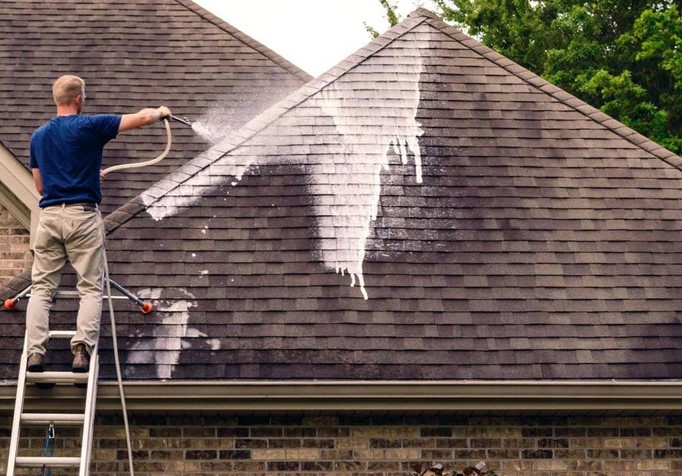
Apply the Roof Moss Remover: Use a low-pressure garden sprayer. Start from the bottom and work your way up to ensure even coverage without the chemical running off too quickly.
-
Dwell Time: Let the solution sit. For oxidizers, 15–20 minutes is usually the sweet spot. For biological cleaners, you just walk away.
-
The Gentle Rinse: If using a fast-acting formula, rinse with a garden hose using a “fan” spray pattern. Always spray downward so you don’t force water up under the shingles.
Analogy: The Exfoliating Facial for Your Home
Think of your roof like your skin. Over time, it accumulates “dead cells” and debris (moss, algae, soot). You wouldn’t use a belt sander to clean your face; you’d use a chemical exfoliant that gently dissolves the bond of the dirt. A Roof Moss Remover is that exfoliant. It does the heavy lifting chemically so you don’t have to do it mechanically.
Expert Advice
The Zinc Strip Secret: If you’ve just cleaned your roof, consider installing zinc or copper flashing strips along the ridge. When it rains, trace amounts of these metals wash down the roof. Zinc is naturally toxic to moss but harmless to your shingles. It’s the “vaccine” that keeps the moss from coming back after your initial “treatment.”
Strategic Maintenance: When to Call a Pro
While DIY chemical maintenance is great for beginners and intermediate enthusiasts, there are three scenarios where I tell people to put down the sprayer and call a specialist:
-
Steep Pitches: Anything above a 6/12 pitch (approximately 26 degrees) is dangerous for an amateur.
-
Fragile Materials: If you have cedar shakes or clay tiles, these require highly specific pH-balanced cleaners that can be tricky to mix.
-
Active Leaks: If moisture is already inside, the cleaner might find its way into your insulation, creating a chemical smell in your home.
Maximizing Longevity with LSI Contextual Care
To truly master roofing integrity, you must understand the ecosystem of your roof. It’s not just about the shingles. You need to ensure your gutters are clear so that the dead moss (which will eventually slide off) doesn’t clog your downspouts.
Furthermore, pay attention to Gloeocapsa Magma—those black streaks that look like soot. They are actually a type of cyanobacteria that often accompanies moss. Most high-quality Roof Moss Remover products are “Dual-Action,” meaning they will kill both the green moss and the black algae streaks simultaneously.
Scannable Maintenance Checklist:
-
Inspect twice a year: Late autumn and early spring.
-
Trim overhanging branches: Moss loves shade. More sunlight = less moss.
-
Check your attic ventilation: Excessive heat in the attic can cook shingles from the inside out, making them more susceptible to organic growth.
Conclusion: A Small Investment for a Lifetime of Shelter
Your roof is the most expensive “wear item” on your home. Treating it with a Roof Moss Remover once every two or three years isn’t just about curb appeal—it’s about structural preservation. I’ve seen homeowners save tens of thousands of dollars simply by respecting the chemistry of their home’s exterior.
Is your roof starting to show a “green tint,” or are you seeing those dreaded black streaks? Don’t wait for the next rainstorm to find a leak. Take a look at your shingles this weekend, and let’s get that biological sponge off your house!
Have you ever tried a “spray and forget” cleaner, or do you prefer the instant results of a rinse-off formula? Let me know your experiences in the comments below!