High-Impact Aesthetic Engineering: Elevating Surfaces with Mosaic Tile
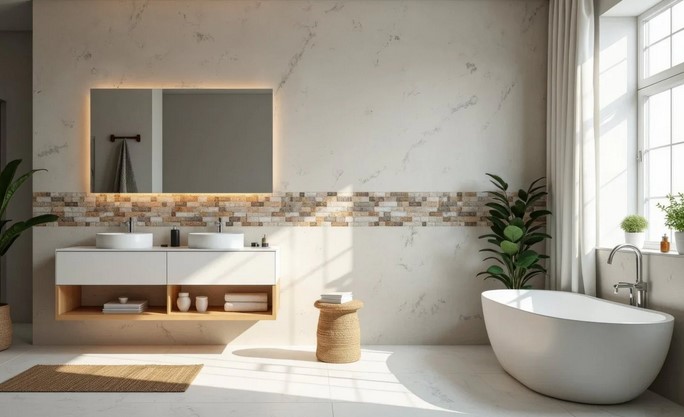
Source:https://www.hyperiontiles.co.uk
You are standing in your kitchen, staring at that blank, greasy drywall behind your stove. You’ve painted it twice, but it still feels “flat.” Or perhaps you’re in your bathroom, looking at a shower floor that feels more like a hospital wing than a spa. Here is a startling reality from my decade in the renovation trenches: The human eye can detect a misalignment of just 1/16th of an inch on a large-format tile, but it finds perfection in the intentional “chaos” of a mosaic.
In my ten years of home improvement, I have seen homeowners spend thousands on expensive marble slabs only for the room to feel cold. Then, I’ve seen a $300 DIY mosaic tile backsplash transform a dull kitchen into a high-end culinary studio. Mosaics aren’t just covers for your walls; they are the jewelry of the home. They provide texture, light reflection, and a sense of “hand-crafted” luxury that a bucket of paint simply cannot replicate.
The Engineering Behind the Beauty: What is Mosaic Tile Exactly?
When I talk to beginners, they often think a mosaic tile project involves glueing thousands of tiny individual stones by hand like a Roman artisan. Thankfully, modern engineering has made our lives easier.
Most modern mosaics come as mesh-mounted sheets, usually 12×12 inches. Think of it like a “tile puzzle” where the pieces are already taped in place. Your job isn’t to place every tiny square; it’s to bridge the gaps between the sheets so the entire wall looks like one seamless tapestry.
Materials Matter: Beyond the Ceramic
In my experience, the “vibe” of your room is dictated by the material density of the mosaic you choose:
-
Glass Mosaics: These are the “mirrors” of the tile world. They bounce light around small, dark bathrooms.
-
Natural Stone (Travertine/Marble): These provide an earthy, organic feel. They are porous, meaning they have “pores” like your skin and require a different level of care.
-
Porcelain and Ceramic: The workhorses. These are durable, easy to cut, and perfect for high-moisture areas like shower pans.
Strategic Deployment: Where Mosaic Tile Shines Brightest
You don’t want to tile every wall in your house with mosaics—that would be like wearing a tuxedo to a backyard BBQ. It’s about High-Impact Aesthetic Engineering. ### The Kitchen Backsplash: The Focal Point
I always tell my clients: if you can only afford one luxury upgrade, make it the backsplash. Because it sits at eye level and is usually bathed in under-cabinet lighting, the mosaic tile becomes the architectural focal point of the entire kitchen.
The Shower Pan: Safety Meets Style
This is a technical insight many beginners miss: Small tiles mean more grout lines. In a shower, more grout lines mean more friction for your feet. Using a mosaic on a shower floor isn’t just about looking like a 5-star hotel; it’s about preventing a slip-and-fall accident. It’s functional engineering disguised as art.
The Technical Deep-Dive: Mastering the Installation
Installing mosaic tile is a game of patience and chemistry. Over the years, I’ve seen “okay” jobs and “masterpiece” jobs. The difference is usually in the thin-set and the trowel.
Choosing Your Adhesive
For glass mosaics, you must use a bright white thin-set specifically rated for glass. If you use a standard gray mortar, the color will bleed through the translucent glass, making your expensive tiles look muddy and cheap.
The “V-Notch” Secret
Because mosaics are thin, using a large floor trowel will cause the mortar to ooze up through the cracks. I recommend a 3/16″ V-notch trowel. It applies just enough “glue” to hold the sheet without making a mess that ruins your grout lines.
Substrate Preparation
Your wall needs to be flatter than a pancake. Because mosaics are flexible (thanks to the mesh), they will telegraph every bump or dip in your wall. If your drywall is wavy, your mosaic will look wavy. I always spend an extra hour with a 4-foot level and some joint compound before I even open a box of tile.
The “Grout Trap”: Why Color Changes Everything
If the tile is the “soul” of the project, the grout is the “skeleton.” It holds everything together and defines the shape.
Analogy Time: Think of grout like the frame on a painting. A dark frame on a light painting makes it “pop” (high contrast), while a light frame makes the whole thing feel airy and soft (low contrast).
-
High Contrast: Dark grout with white mosaic tile creates a “grid” look. It’s very modern and industrial.
-
Low Contrast: Matching the grout color to the tile makes the surface look like a solid, shimmering sheet. This is better for making small spaces feel larger.
Expert Advice: The “Anti-Sag” Trick
Mosaics are heavy. On a vertical wall, gravity wants to pull that mesh sheet down while the mortar is wet. To prevent this, I use “starter strips”—a perfectly level piece of wood screwed into the wall at the bottom of the backsplash. This gives the tiles a “shelf” to sit on while they cure.
Hidden Warnings: The Pitfalls of Mosaic Maintenance
I would be doing you a disservice if I didn’t mention the “hidden” work. More grout means more surface area for mold and soap scum.
-
Sealing is Mandatory: If you are using stone or unglazed ceramic, you must apply a high-quality penetrating sealer. This fills the microscopic holes in the grout and stone so that red wine or spaghetti sauce can’t move in permanently.
-
Avoid Abrasives: Glass mosaics scratch easily. Never use steel wool or harsh scouring powders. A simple mixture of vinegar and water with a soft microfiber cloth is all you need to keep that shimmer alive.
Pro Tip: Managing the “Sheet Lines”
The biggest “rookie” mistake is seeing the square lines between each 12×12 sheet. To avoid this, I use a technique called staggering.
Instead of lining up the sheets like a perfect grid, offset them like bricks in a wall. This breaks up the vertical lines and tricks the eye into seeing one continuous surface. Also, use a “Grout Float” (a rubber-bottomed tool) to firmly press the sheets into the thin-set. If you use your hands, you’ll create “finger dents” that make the tile surface uneven.
At the end of the day, home improvement is about more than just resale value—it’s about how you feel when you walk through your front door. Mosaic tile offers a level of customization and “aesthetic engineering” that few other materials can match. Whether it’s a shimmering glass backsplash or a slip-resistant stone shower floor, you are building a surface that is as durable as it is beautiful.
Don’t let the “technical” side of tiling intimidate you. Take it one sheet at a time, respect the prep work, and watch your home transform.
What area of your home are you planning to upgrade? Are you leaning toward the modern shimmer of glass or the timeless texture of stone? Share your project ideas or ask your toughest tiling questions in the comments below—I’m here to help you get it right the first time!